
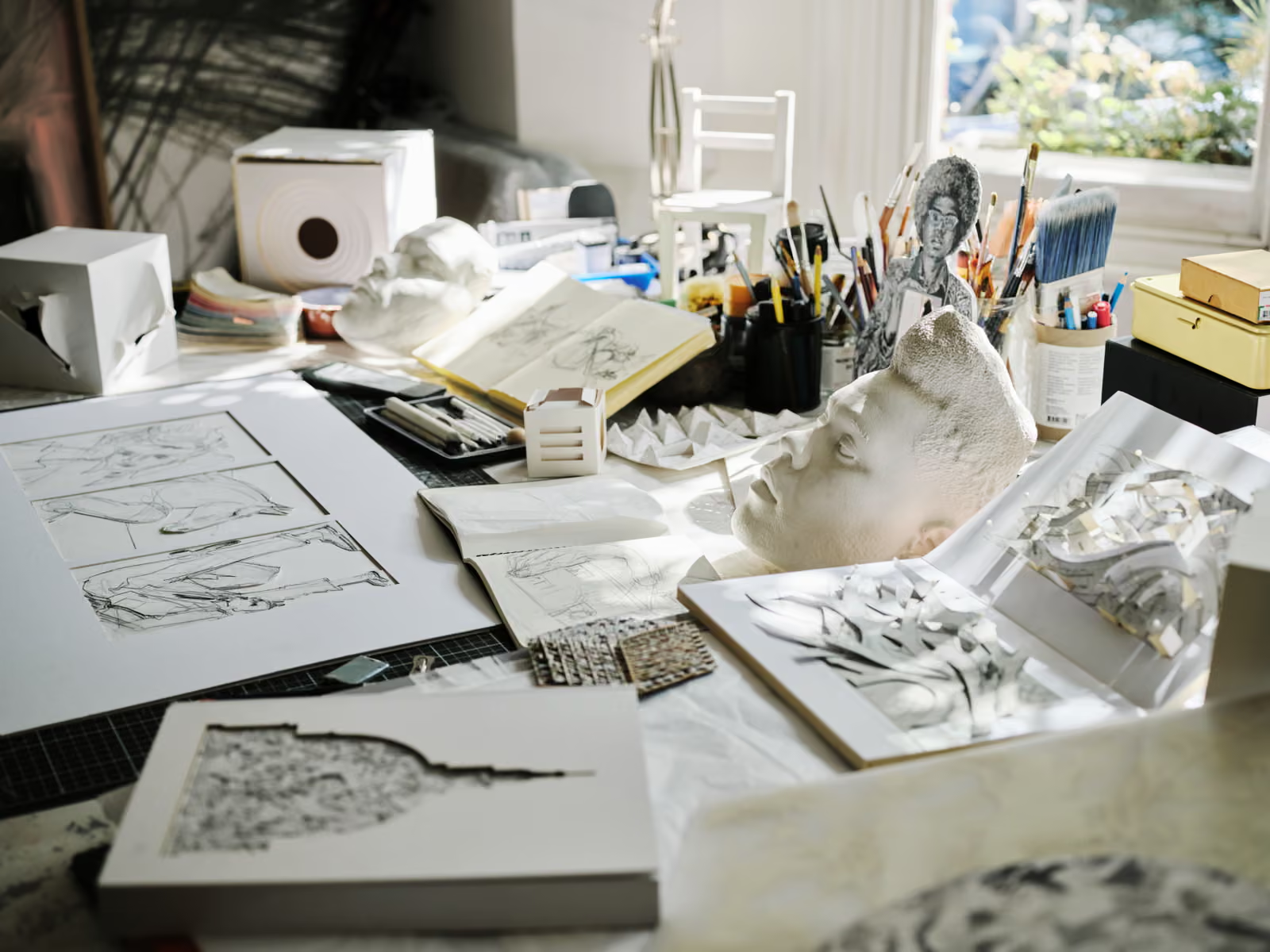
Set designer Es Devlin, the go-to for Beyoncé, Lady Gaga and the Olympics, opens up about her career, her "everythingist" ethos and her new retrospective.
Few designers can claim Beyoncé, Lady Gaga, Bad Bunny, two Super Bowl half-time shows, two Olympic ceremonies and the Louvre on the same CV. Es Devlin can, and the London-based artist has now given the Guardian a rare glimpse inside her studios ahead of a major retrospective of her work.
The story behind her ethos begins with the Russian avant-garde. Four years ago, curators at the V&A East Storehouse invited Devlin to respond to a 100-year-old theatrical backdrop by artist and designer Natalia Goncharova, painted for a 1926 London production of The Firebird by the Ballets Russes.
Devlin admits she did not know much about Goncharova, but quickly recognised a kindred spirit. “She called herself an ‘everythingist’,” Devlin said, a description that also inspired the title of her sculptural response, The Everythingists.
It is a label that fits her own sprawling practice. In the 30 years since winning the Linbury prize for stage design in 1995, Devlin has become the go-to set designer for highbrow theatre, international opera, global pop, official celebrations, fashion runways and public sculpture.
Her trophy cabinet includes three honorary doctorates, multiple Oliviers, Tonys, Emmys and Critics’ Circle awards, the London Design Medal, an OBE and a CBE. Her ability to pair intricate handicraft with arena-level spectacle has also caught the eye of contemporary art curators such as Hans Ulrich Obrist and Ekow Eshun, and even theoretical physicists, with Carlo Rovelli a known fan.
Speaking from her garden in south London ahead of the retrospective, Es Devlin: Other Worlds at the Design Museum in London, Devlin recalled the scepticism she faced at school.
“When I was at school, the teachers used to say: ‘You’re a jack of all trades and master of none,’ and it’s only recently that I learned that phrase actually has another couplet, which is, ‘But oftentimes better than a master of one,'” she said.
To her mind, “it’s an injustice to the condition of being alive to seek only depth at the expense of breadth,” adding that she believes greater depth comes from expanding one’s line of inquiry.
Her home doubles as her studio, separated by floor-to-ceiling mirror doors, with two ginger cats weaving between giant turned-wood vessels and a pair of sculpted hands the height of a person. Those hands are maquettes for the floating 25-metre-tall set she designed for Carmen at the Bregenz Festspiele in 2017.
She is relishing the prospect of clearing her studio walls once the retrospective opens. “I’m actually quite excited about moving everything from that studio into the Design Museum because I’ll have every space clear and nothing on the walls. And then I just need to sit in there and make stuff,” she said.
The retrospective maps 30 years of Devlin’s practice across sculpture, film and installation, with archival drawings, paintings, collages, diaries and prints revealing how she works.
At its core is a large circular piece combining several milestone projects, including the 2021 mirror-maze Forest of Us, the rotating glass box set she designed in 2018 for The Lehman Trilogy, directed by Sam Mendes, and the Union Jack stadium-floor covering created for the London 2012 Olympics closing ceremony.
In 2023, she published the monograph An Atlas of Es Devlin, a double fold-out list of more than 120 projects from over three decades. A revised edition adds 30 new projects, evidence of an unrelenting workflow.
Recent work includes the set for Rajiv Joseph’s Archduke at London’s Royal Court, a retrospective at Futura Seoul, and London Oratorio, a one-night South Bank production with musician Jacob Collier, composer Kieran Brunt and scores of the capital’s choristers. She is also designing Olivia Rodrigo’s forthcoming arena tour, writing a book, planning a ball, and setting up a new studio in Sussex.
When does she sleep? “I get plenty of sleep. But I do have quite a lot of things…” She gestures to the tree above her. “I wouldn’t be able to do what I’m doing today if I hadn’t done what I did yesterday. It’s an accumulation. It’s a tree that’s growing.”
Esmeralda Devlin was born in Kingston upon Thames in 1971 to a journalist father and a teacher mother, both of whom she considers artists. When she and her three siblings were all under 10, her parents took in three cousins for a year, fitting seven children into a three-bedroom house.
Gift-giving was an exercise in creativity. “Any time there was a Christmas or a birthday, you know, my mum would just say: ‘Well, you can’t buy anything. Make something,'” Devlin recalled.
Beyond gifts, she invented systems, built a periscope from her mother’s makeup mirror, and devised complicated games her father suggested sending to games company Waddingtons. Tuesday nights meant a rush to return library books, hers invariably buried “under a pile of yoghurt pots, and cardboard boxes and toilet rolls” because she would be building elaborate runs for the family gerbils.
The family later moved to Rye on the East Sussex coast, where the theatricality of church services and the town’s pagan-flavoured bonfire pageants left a mark. Most mesmerising of all was the Rye Town Model next door, a son et lumière recreation of the town’s history, where each miniature house lit up as it spoke.
She can still recount its tales: “There was a story about a monk and a nun who got bricked up in the walls for having an affair. There was a story about a butcher murdering somebody.” But what truly stuck was the sensation of holding her own home in miniature. She found it enchanting that “a building that I lived in was small enough for me to hold,” while next door, “I’d be in my house and my house would be holding me.”
Music runs like a golden thread through her life. She took all her grades in violin, clarinet and piano before realising as a teenager that her path lay in “something that fused my knowledge of music and my practice of music, with other things.”
After an English literature degree, a foundation course at Central Saint Martins, and a year on the Motley theatre design course at Theatre Royal Drury Lane, the path illuminated. She won a job designing Marlowe’s Edward II at the Octagon theatre in Bolton, which led to a piece at London’s Bush theatre, seen by Trevor Nunn, then artistic director of the Royal National Theatre, who promptly hired her for Harold Pinter’s Betrayal. Then came Rambert Dance Company’s Four Scenes, the show that inaugurated the new Sadler’s Wells in 1998, when Devlin had just turned 27.
“It was a very rapid baptism of fire,” she said.
Was she intimidated working at that level so early? “I think I was insufficiently intimidated,” she replied. “By then, I had been in education a long time and there was a lot I wanted to express.”
That unflappable, gung-ho attitude has carried her everywhere from Compton to the Louvre, Morocco’s Agafay Desert and Malawi, collaborating with artists from Rosalía and Kendrick Lamar to Max Richter. In 2013, she told the Guardian that a career low point was sending groundplans to Shakira while in labour.
Young artists often ask how she holds on to her identity when working with powerful people. “The best answer I’ve given to this question is: I actually am not too afraid to lose my identity. By being prepared to lose it, you encounter other aspects that are probably more interesting,” she said.
Yet she never disappears into someone else’s world, which is precisely why the big names seek her out.
“What I’ve observed about powerful people is, it’s unfortunate, but a bit like barnacles on a great whale, there are peripheral structures that accumulate around power and fame. And to the powerful person and the famous person, those structures are really uninteresting,” she observed.
The coherence of her work, its unmistakable “Es Devlinness,” recurs across every client. Leitmotivs such as the line of light, the glowing box, the map, the tree-lung, and the egg that opens appear again and again. Her conceptual imperatives are equally clear: no interest in decoration, everything must have meaning, the audience must have agency, materiality matters, and portraiture is fundamental.
“Everything is both a portrait of the collaborator and a self-portrait at the same time,” she said.
Her second studio in Peckham, south London, hums with design associates rendering 2D and 3D visualisations for Rodrigo’s arena tour and the Design Museum floorplan, while a model-maker puts finishing touches to a miniature of Library of Light, Devlin’s 18-metre revolving cylindrical bookshelf holding 3,200 books, designed for Milan’s Salone del Mobile in 2025. Beside her sit reused takeaway boxes of tiny fake books; she reckons she has made about 1,800.
Over lunch, she invoked artist William Kentridge’s labelling system. “I was speaking with William Kentridge about the way he labels his projects, and he has ‘urgent’, ‘desperate’, ’emergency’ and ‘SOS’. That’s definitely how we could label our projects,” she said.
What qualifies as SOS right now? “The Design Museum is SOS,” she said, as is the 2026 British Museum Ball in October, where she serves as artistic director. After touring the museum and meeting six staff members with 137 years of combined service, she decided her design should communicate the museum’s staff, all 1,000 of them, positioning them as protagonists, much as she did with the 50 refugees she portrayed for her UNHCR installation Congregation in 2024, and the 55 million adults invited to take part in A National Portrait project for London’s National Portrait Gallery.
That people and real lives are central to her work shows in the way she includes her team in conversations and treasures their contributions. One associate, who trained as an architect, recalled thinking on graduation: “There’s got to be something else out there. This is surely not it.” Devlin’s studio, it seems, is a haven for like-minded seekers interested in everything and wanting more.
Over coffee and dark chocolate, she showed off prototypes of kinetic silver rings bearing her signature motifs: an iris, a spinning cube, a minute Venus of Willendorf, and an egg that opens to reveal a tree or a lung. They are memory aids for a book she is writing.
“I’m writing a book called The Compass of Es Devlin,” she said, “which is sort of elucidating various practices that have helped me. And these are to help me remember them. It’s almost like they’re little cues.”
To watch her manipulate the tiny sculptures is to see what she must have been like as a small child, utterly engrossed in the creative task at hand: Es Devlin, the everythingist.
Frequently Asked Questions
Who is Es Devlin?
A British artist and set designer, born in Kingston upon Thames in 1971, known for designing stages for Beyoncé, Lady Gaga, Bad Bunny, two Super Bowl half-time shows, two Olympic ceremonies, fashion runways and public sculpture.
What does Es Devlin mean by “everythingist”?
A term she adopted after learning that the Russian designer Natalia Goncharova used it to describe her own kaleidoscopic approach, spanning multiple disciplines rather than a single specialism.
What is Es Devlin: Other Worlds?
A retrospective of 30 years of Devlin’s practice at the Design Museum in London, spanning sculpture, film, installation, and archival drawings, paintings, collages, diaries and prints.
What are Es Devlin’s biggest projects?
Highlights include the rotating glass box set for The Lehman Trilogy (2018), the Forest of Us mirror maze (2021), the London 2012 Olympics closing ceremony floor, the Carmen set at Bregenz (2017), and Library of Light in Milan (2025).
What awards has she won?
Three honorary doctorates, multiple Oliviers, Tonys, Emmys and Critics’ Circle awards, the London Design Medal, plus an OBE and a CBE.
What is she working on now?
Olivia Rodrigo’s forthcoming arena tour, the 2026 British Museum Ball as artistic director, a book titled The Compass of Es Devlin, and a new studio in Sussex.
