US Diplomat Defends Kenya Health Deal Amid Patient Data Privacy Concerns
The United States government has defended its approximately KSh323 billion health cooperation agreement with Kenya, seeking to reassure the public over concerns about the handling and sharing of sensitive patient information under the partnership.
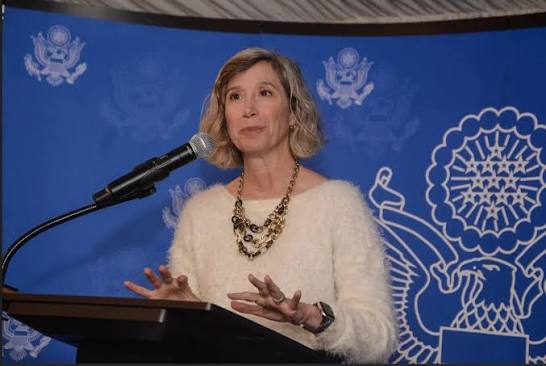
US Embassy Acting Chargé d’Affaires Carla Benini said health information shared under the arrangement would be anonymised, meaning personal identifiers would be removed before the data is used to study disease patterns and guide healthcare interventions.
Speaking during an interview with NTV on Wednesday, November 25, 2026, Benini maintained that the agreement did not introduce unusual data-sharing arrangements compared with other health cooperation frameworks involving the United States.
“I think it is important to note that there is nothing that is being done differently from other frameworks. I think Kenya is one of our strongest partners in the Sub-Saharan region,” she said.
The diplomat dismissed concerns that the partnership would expose individual patients’ medical information, explaining that the data would be separated from personal identities and used to monitor the spread and impact of diseases across populations.
“There is data that is collected that is completely removed from an individual. It has literally nothing to do with an individual. In simple terms, it is anonymised. There should not be any data privacy concerns among the Kenyan people,” Benini stated.
She added that sharing health information would enable Kenya and the United States to better understand disease trends and identify appropriate interventions to address public health challenges.
The remarks come amid ongoing public debate over the Kenya-US Health Cooperation Framework, a five-year agreement signed on December 4, 2025, valued at approximately US$2.5 billion.
The partnership is intended to strengthen Kenya’s healthcare system through support for HIV, tuberculosis and malaria programmes, disease surveillance, laboratory services, medical supplies, digital health infrastructure and healthcare workers.
The agreement also provides for support to the Kenya Medical Supplies Authority (KEMSA), including efforts to improve the availability of essential medicines and strengthen supply chain systems. It further supports the expansion of digital health services under the government’s Digital Health Superhighway.
Benini said American funding would be higher during the initial years to help Kenya establish the structures needed to strengthen its healthcare system before gradually assuming greater responsibility for financing and managing services.
“The investment from the U.S. government is high in the early years at 1.6 billion, and that is just to ensure Kenya has the health system structures in place,” she explained.
She described the arrangement as part of a broader shift in American foreign assistance policy towards a model that prioritises trade and long-term sustainability rather than continued dependence on aid.
“Our current administration is looking to emphasise a trade-not-aid model, and the idea is that after the end of those five years, Kenya will be able to stand on its own,” she said.
However, the agreement has faced legal challenges over the proposed sharing of health information, protection of sensitive personal data and the level of public participation during negotiations.
A constitutional petition filed at the High Court has questioned whether the framework and related data-sharing arrangements comply with Kenya’s Constitution and the Data Protection Act.
The legal challenge also raises concerns about the handling of health information across borders and the safeguards available to protect patients’ privacy. In December 2025, the High Court issued interim orders restricting implementation of provisions involving the transfer, sharing or dissemination of sensitive health information.
The case remains unresolved. The High Court postponed delivery of its judgment, which is now scheduled for November 30, 2026.
Benini’s comments represent the US government’s position on the privacy safeguards under the agreement, while the outstanding court proceedings will determine the legal questions raised by the petition.