
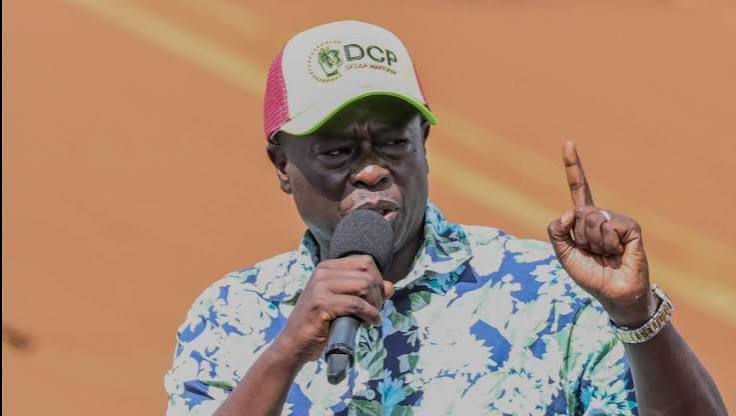
Former Deputy President Rigathi Gachagua has defended his three-bloc Opposition alliance proposal after Fred Matiang’i and Justin Muturi accused him of political arrogance and bullying.
Former Deputy President Rigathi Gachagua has defended his approach to building Opposition unity, dismissing accusations of arrogance and political intimidation from Jubilee Party leader Fred Matiang’i and Democratic Party leader Justin Muturi.
Gachagua said his proposal to bring together political blocs from Mt Kenya, Ukambani and Western Kenya was based on electoral calculations and the need to secure enough votes to challenge for the presidency in the 2027 General Election.
Speaking at his Wamunyoro residence in Nyeri on Tuesday, November 3, where he hosted a delegation from the county, the Democracy for the Citizens Party (DCP) leader maintained that his direct style should not be mistaken for arrogance or bullying.
“Some my friends think that I am arrogant for being truthful. I am not arrogant. I am just truthful,” Gachagua said.
He added that calls for fellow Opposition leaders to organise and mobilise supporters had been interpreted by some as attempts to intimidate them.
Gachagua’s remarks followed criticism from Muturi, who had cautioned against what he described as political bullying and ultimatums in engagements among Opposition leaders.
Muturi argued that no individual or community should claim ownership of the Opposition or assume an exclusive right to Kenya’s presidency.
He maintained that political partnerships should be founded on mutual respect rather than intimidation or competition for dominance.
Matiang’i also criticised Gachagua’s proposal to consolidate support from particular regions, warning that what he termed majoritarian arrogance could undermine efforts to unite the Opposition.
Speaking during a television interview, Matiang’i said such an approach risked creating divisions and making cooperation among Opposition leaders more difficult.
In response, Gachagua insisted that anyone seeking the presidency must demonstrate the ability to attract voters, regardless of their political experience or policy positions.
“I have told those leaders that, when you want to be the president of Kenya, you must be voted for, regardless of the policies you have,” he said.
He argued that winning elections required sustained grassroots mobilisation, adding that votes could not be secured simply through media appearances or meetings in hotels.
According to Gachagua, Opposition leaders should openly discuss their support bases and develop strategies for building a winning coalition.
“Politics is a game of numbers. The science of politics is numbers. We are anticipating there shall be 26 million [registered voters]. To be on the safe side we must get 13 million plus 1. ..we must look for those numbers,” he said.
The former Deputy President also relied on his experience in the 2022 General Election to defend his emphasis on voter mobilisation.
He claimed that his efforts to consolidate political support had contributed significantly to William Ruto’s presidential victory.
“I am a believer of numbers. I am also experienced. I delivered the presidency in the last election [2022] through mobilisation of numbers. Some are uncomfortable discussing numbers; but they must be discussed,” Gachagua said.
His comments highlight the growing differences among Opposition figures over how to organise a coalition capable of challenging President Ruto in 2027.
While Gachagua is pushing for a strategy built around regional voting blocs and numerical strength, Matiang’i and Muturi have emphasised the importance of mutual respect and avoiding political dominance in efforts to bring leaders together.
