
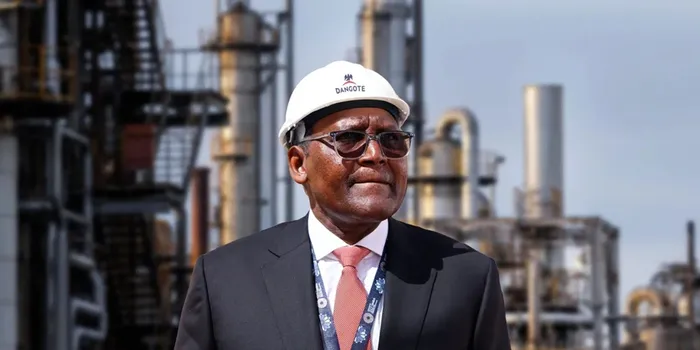
Aliko Dangote says the Lamu refinery will have a 1,000MW power plant, with 500MW sold to the Kenyan government, as Ruto confirms land is secured.
Billionaire Aliko Dangote has unveiled plans to generate electricity at the planned Lamu refinery and sell part of it to the Kenyan government, adding a power business to what is already Kenya’s largest single private investment.
Speaking on Friday, September 25, during President William Ruto’s tour of the Dangote Petroleum Refinery in Lekki, Nigeria, the African billionaire said the Lamu facility will carry a 1,000-megawatt power plant, with half of that output potentially heading to the Kenyan market.
“We are going to produce about 1,000 megawatts in Lamu and have 500 megawatts to sell to the Kenyan government,” Dangote said.
Dangote framed electricity generation as one piece of a wider investment that he said would act as an entry point for additional businesses into Kenya.
“What this investment will do to Kenya’s economy is not only the refinery. The refinery is actually the gate. Once you open the refinery, you will be shocked at how many people will come to invest in Kenya,” he said.
Once operational, the facility is expected to process crude oil from Kenya’s oilfields in Lokichar, Turkana County, while pumping refined petroleum products into markets across East and Central Africa.
The plant is projected to refine about 700,000 barrels of crude per day, a scale that would make it a central pillar of Kenya’s push to expand its petroleum refining capacity.
Dangote also indicated the Lamu project would feature equipment that is not available at his Nigerian refinery, including a coker, while its Residual Fluid Catalytic Cracker (RFCC) would be larger than the Nigerian version.
During the visit, President Ruto said his administration is fully behind the multi-trillion-shilling project and has already locked down the land needed for its development, clearing the path for construction to start.
“We are not looking at this as just a refinery. We are looking at it as a refinery that is also going to elevate our industrial scale. We have already secured the land for this project,” Ruto said.
The project is being developed with Dangote’s involvement and backing from the Africa Finance Corporation, with its value estimated at between Ksh1.94 trillion and Ksh2.20 trillion.
The refinery was initially earmarked for Tanga in Tanzania before the Dangote Group shifted it to Lamu in Kenya, citing infrastructure, logistics, and market considerations.
The announcement came a day after a GW70 onshore drilling rig valued at more than Ksh2.6 billion ($20 million) docked at the Port of Mombasa, another signal that Kenya’s oil ambitions are gathering pace.
The rig, leased by Gulf Energy E&P BV SEZ from Great Wall Drilling Company (GWDC), arrived at Kilindini Port on Friday, September 25, after being shipped from Duqm Port in Oman aboard MV Transit Sedanka.
Gulf Energy E&P BV SEZ Chief Executive Officer Paul Limoh said drilling is scheduled to begin on November 1, with the first phase of crude production targeted for December 2026.
Frequently Asked Questions
How much electricity will the Lamu refinery generate?
Dangote said the facility will produce about 1,000 megawatts, with 500 megawatts potentially sold to the Kenyan government.
When did Dangote make the announcement?
On Friday, September 25, 2026, during President William Ruto’s visit to the Dangote Petroleum Refinery in Lekki, Nigeria.
How much crude will the Lamu refinery process?
About 700,000 barrels per day, drawing crude from Kenya’s oilfields in Lokichar, Turkana County, and supplying refined products to East and Central African markets.
What is the value of the Lamu project?
The investment is estimated at between Ksh1.94 trillion and Ksh2.20 trillion, developed with support from the Africa Finance Corporation.
Why was the refinery moved from Tanzania to Kenya?
The Dangote Group shifted the project from Tanga in Tanzania to Lamu, citing infrastructure, logistics, and market considerations.
What equipment will Lamu have that the Nigerian refinery lacks?
A coker, along with a larger Residual Fluid Catalytic Cracker (RFCC) than the one at the Lekki facility in Nigeria.
When will drilling start in Turkana?
Gulf Energy E&P BV SEZ says drilling begins on November 1, 2026, with first-phase crude production targeted for December 2026, using a GW70 rig that docked at Mombasa on September 25.
