
IEBC has clarified why foreign names appeared among 304 applicants for the Commission Secretary and CEO position, confirming that only Kenyan citizens who met the requirements were shortlisted after the verification process.
The Independent Electoral and Boundaries Commission (IEBC) has explained why foreign names appeared on the list of 304 applicants seeking the position of Commission Secretary and Chief Executive Officer (CEO), insisting that only qualified Kenyan citizens progressed to the final shortlist.
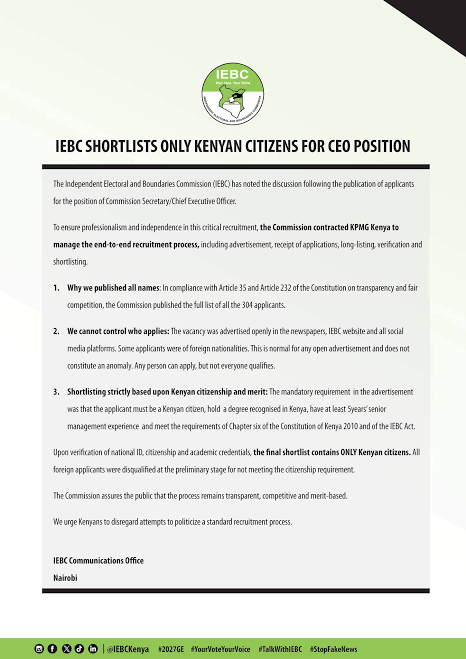
IEBC Says Only Kenyans Qualified for CEO Job After 304 Applications
The clarification follows public concerns over the inclusion of names perceived to belong to foreign nationals in the list published by the electoral commission.
In a statement, IEBC maintained that all non-Kenyan applicants were eliminated during the initial screening after the verification of citizenship and academic qualifications.
The commission said publishing the names of all 304 applicants was part of its commitment to transparency, accountability and fair competition in public recruitment.
According to IEBC, the disclosure was guided by Articles 35 and 232 of the Constitution, which address access to information and the principles governing public service.
IEBC Explains Recruitment of Commission Secretary
The electoral agency said it engaged KPMG Kenya to provide oversight throughout the recruitment exercise.
The firm’s responsibilities included advertising the vacancy, receiving applications, conducting preliminary assessments, verifying qualifications, preparing the longlist and developing the final shortlist.
IEBC said the vacancy was advertised through newspapers, its official website and social media platforms to attract applications from eligible candidates.
The commission explained that an open recruitment process allows different individuals to submit applications, but meeting the advertised requirements remains mandatory.
It dismissed suggestions that the appearance of foreign names on the published register indicated flaws in the recruitment exercise.
IEBC noted that it could not prevent people of different nationalities from submitting applications, but only candidates who satisfied the legal requirements could advance.
Kenyan Citizenship Was a Mandatory Requirement
The commission clarified that Kenyan citizenship was among the key qualifications for the Commission Secretary and CEO position.
Other requirements included possession of a recognised university degree, at least five years of senior management experience and compliance with Chapter Six of the Constitution and the IEBC Act.
IEBC said it examined applicants’ national identification documents, citizenship status and academic credentials before determining those eligible for shortlisting.
Following the verification exercise, the commission confirmed that every candidate on the final shortlist was a Kenyan citizen.
Foreign nationals who submitted applications were excluded at the preliminary screening stage for failing to meet the citizenship requirement.
IEBC Defends Transparency in CEO Recruitment
The commission maintained that the recruitment exercise was being conducted in accordance with constitutional principles, with an emphasis on professionalism, fairness and merit.
It also called on members of the public to avoid politicising the process, assuring Kenyans that the selection was proceeding under established recruitment procedures.
The clarification comes as IEBC moves towards filling the position of substantive Commission Secretary and Chief Executive Officer.
The office is critical to the commission’s operations, with the holder responsible for overseeing administrative functions and supporting the implementation of electoral activities across the country.
The appointment is therefore expected to play an important role in strengthening the commission’s institutional capacity ahead of future elections.
